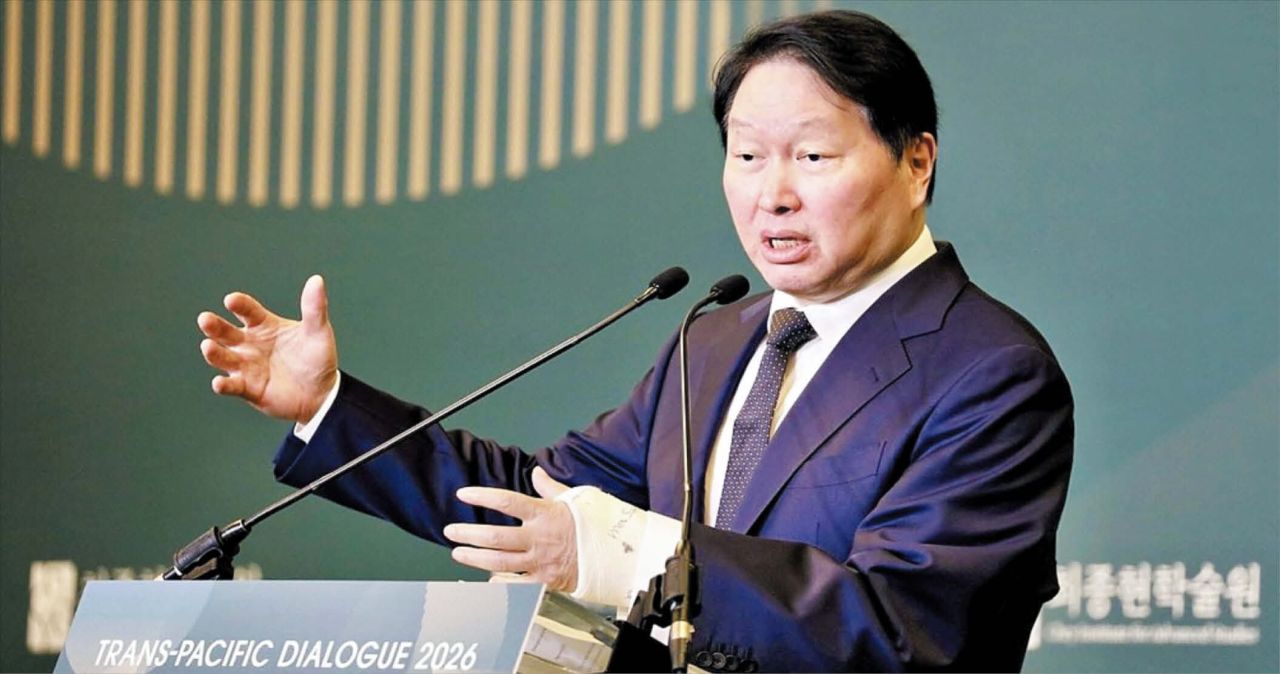
SK Group Chairman Chey Tae-won, one of the key figures driving the global artificial intelligence (AI) semiconductor market, warned that “AI is swallowing everything,” potentially shaking the global industrial ecosystem. He highlighted that an AI-driven “black hole” is absorbing memory semiconductors, causing prices for chips and electronics like PCs, smartphones, and home appliances to surge—a phenomenon dubbed “chipflation” (a portmanteau of “chip” and “inflation”). This could force hardware manufacturers into compulsory restructuring. Additionally, while global big tech companies are positioned as “super subcontractors” lining up to lead the industry, they are grappling with extreme uncertainty, unable to predict the situation even months ahead.
◇“AI is toppling everything”
Chairman Chey made these remarks on the 20th (local time) at the annual forum “Trans Pacific Dialogue (TPD),” hosted by the Chey Institute for Advanced Studies in Washington, D.C. He stated, “New technologies like AI bring not only solutions but also massive volatility that can disrupt everything.” As chairman of the Chey Institute for Advanced Studies, named after his father, he emphasized the dual-edged nature of AI.
Using SK Hynix, a producer of HBM (high-bandwidth memory)—a core component of AI semiconductors—as an example, he noted, “Last December, the market expected SK Hynix’s operating profit this year to exceed $50 billion. By January, estimates rose to $70 billion, and now they exceed $100 billion. While this seems positive, it also means volatility is so extreme that $100 billion in profit could turn into a $100 billion loss.” He added, “Situations change so rapidly that planning even a year ahead is meaningless. There are drastic shifts between the start and end of the year.”
He cited the “memory price distortion” phenomenon. While HBM, a high-value product, might seem more profitable, its margin is 60%, whereas general-purpose chips, now in short supply due to concentrated HBM production, have an 80% margin. “Selling general chips is more profitable than HBM,” he said. “AI infrastructure is absorbing all memory semiconductors, creating an entirely different narrative.”
Chey also highlighted industry changes from “memory shortages.” He stated, “PC and smartphone manufacturers, unable to produce as before due to chip shortages, may exit the business.” For instance, DRAM prices surged from $1.40 in January last year to $11.50—an eightfold increase. Market research firm TrendForce predicts smartphone production could drop by up to 15% this year due to rising memory prices. While Samsung, which produces its own memory chips, and Apple, with a strong premium fanbase, can absorb some price hikes, mid- to low-tier brands will face significant impacts.
Since early this month, Chairman Chey has met with big tech CEOs, including NVIDIA’s Jensen Huang, Meta’s Mark Zuckerberg, Google’s Sundar Pichai, Microsoft’s Satya Nadella, and Broadcom’s Hock Tan. He explained, “The shortage of AI memory exceeds 30%.” He added, “We’re apologizing in advance because we can’t meet customer demands.”
◇“AI power demand could become a disaster”
Chey also identified “energy” and “finance” as critical challenges in the AI era. “AI is consuming all the electricity we need,” he warned. “If power demand isn’t managed, the consequences will be a disaster and a major societal challenge.” He noted that building AI data center infrastructure in the U.S. alone requires $5 trillion (approximately 7,240 trillion Korean won), predicting that nations with financial and resource capabilities will lead the AI race.
He stressed, “During this AI transition, South Korea, the U.S., and Japan must not only identify challenges but also collaborate closely to create practical solutions.”
By Soonchan Park